Almost every student benefits from feedback on an application essay. A teacher, a parent or a consultant can spot unclear sentences, weak structure or missed opportunities that the writer cannot see. But there is a point at which help stops being help and becomes authorship by someone else. Families deserve a clear account of where that point lies.
Why it matters
Application essays exist so that universities can hear from the applicant directly. When an essay is written by someone else, it misrepresents the student to the people deciding on their future. Many universities and application systems ask applicants to confirm that their work is their own, and some use tools to check for copied or generated text.
There is a practical cost too. An essay that does not sound like the student can clash with their reference, their interview or their school record. Admissions readers are experienced, and a polished voice that belongs to an adult is often easier to recognise than people assume.
What good feedback looks like
Helpful feedback works through questions and observations rather than replacement text. It might involve:
- Pointing out where a reader loses the thread or becomes confused.
- Asking what the student meant by a vague phrase, then letting them rewrite it.
- Suggesting that a paragraph be cut, moved or developed.
- Noting where a claim needs a specific example.
- Flagging spelling, grammar and word-count issues.
- Discussing the essay's overall structure and purpose.
In every case, the student makes the change. The ideas, the experiences and the words remain theirs.
Where it becomes ghost-writing
The line is crossed when someone other than the student supplies the substance or the language. Signs include:
- Rewriting sentences or paragraphs and handing them back for the student to accept.
- Choosing the topic and telling the student what to say about it.
- Adding experiences, reading or reflections that are not the student's own.
- Producing a draft for the student to edit, whether by hand or with software.
Generative writing tools deserve particular care. Using them to produce essay text raises the same problems as having another person write it, and many universities set out their own expectations about such tools. Students should read the current guidance from each university and application platform.
Protecting the student's voice
Voice is not about clever phrasing. It is the sense that a real, particular person is speaking. It comes from the student's own choices of what to include, how to describe it and what to make of it. Heavy editing tends to smooth those choices away, leaving prose that is correct but anonymous.
A few habits help preserve it:
- Limit the number of people giving feedback. Too many readers pull an essay in different directions.
- Give feedback in comments rather than edits to the text.
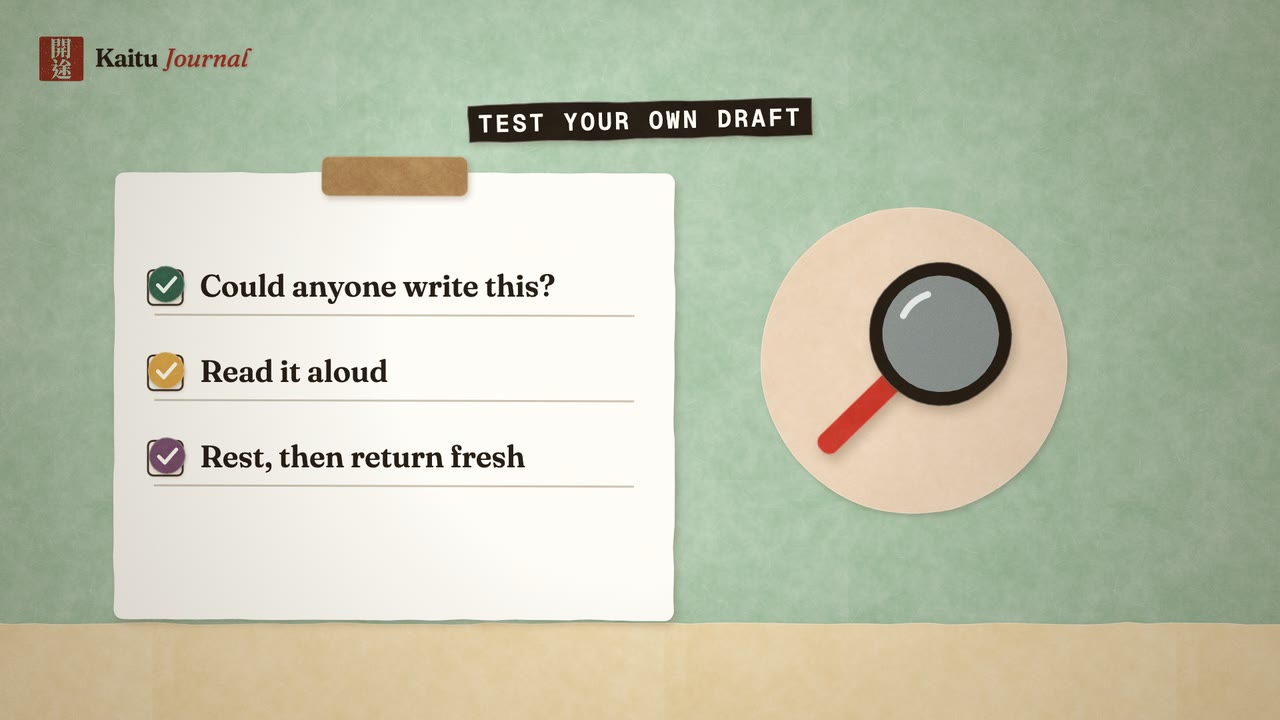
- Ask the student to read the final version aloud. If it does not sound like them, something has gone wrong.
A note for parents
It is natural to want to help, and parents often know their child's experiences better than anyone. The most useful role is usually as a sounding board: talking through ideas and memories before drafting, then reading for clarity once a draft exists. Resist the urge to rewrite.
How Kaitu helps
Our consultants give structured, question-led feedback that strengthens an essay while keeping it entirely the student's work. We do not write essays for applicants. To learn how we support students through drafting, visit our admissions page or book a free consultation.