Branch, subsidiary or new company: choosing a structure abroad

When a business expands to another country, the choice of structure shapes liability, tax, banking and immigration. A plain-language guide to the three common options.

Kaitu Editorial25 April 2026 · 3 min read
A papercraft tree with three branching paper limbs, each holding a small paper building

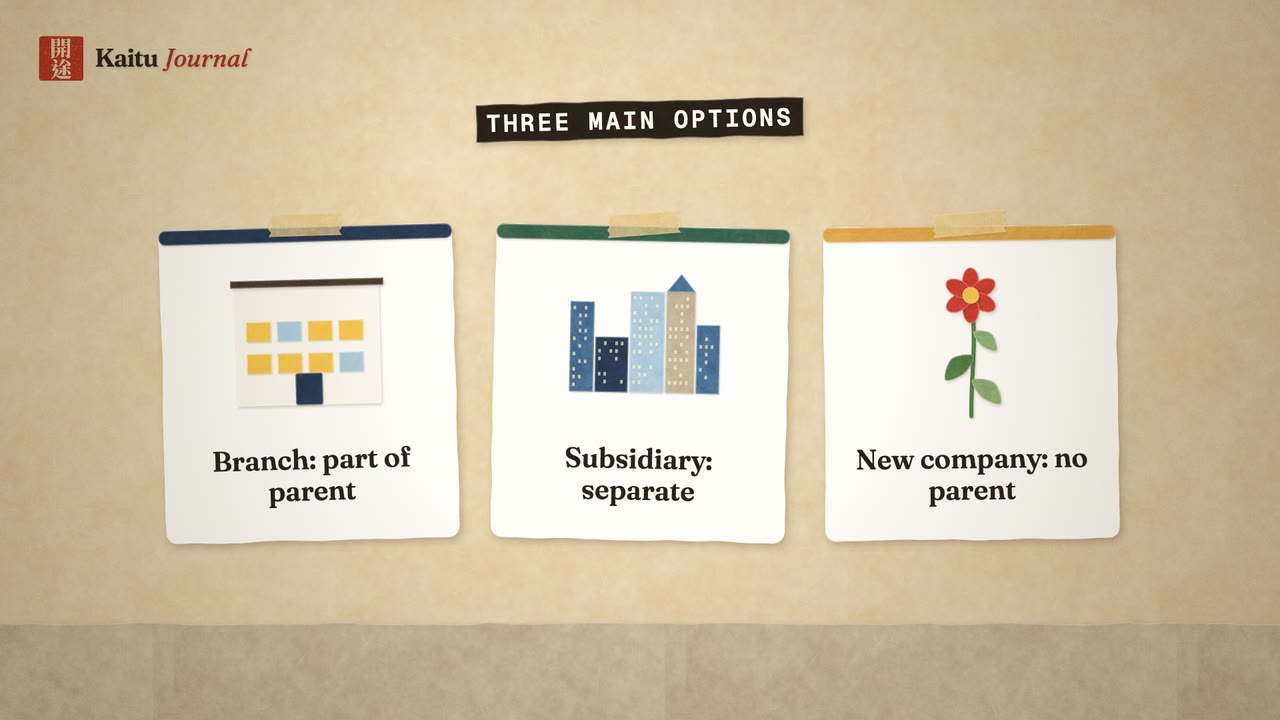
When an existing business expands abroad, or a founder sets up in a new country, one of the earliest decisions is the legal shape the business will take there. The three options most people consider are a branch, a subsidiary or an entirely new, independent company. Each works differently, and the right choice depends on what you are trying to achieve.

A branch

A branch is usually an extension of an existing company into another country, rather than a separate legal person. In general terms:

  • The parent company remains directly responsible for the branch's obligations.
  • The branch normally registers locally and keeps local records, but is not a company in its own right.
  • It can be a simpler way to test a market or support existing customers.

The main consideration is liability. Because the branch is part of the parent, problems abroad can reach the parent company directly. Some banks, customers and regulators also prefer to deal with a locally incorporated entity.

A subsidiary

A subsidiary is a separate company, formed in the new country and owned wholly or partly by the existing business. Generally:

  • It is a legal person in its own right, with its own directors, accounts and filings.
  • Liability is usually contained within the subsidiary, though this depends on how it is run and funded.
  • It is often seen locally as a more permanent commitment, which can help with customers, hiring and banking.

Subsidiaries usually carry more administration, and transactions between the parent and the subsidiary need to be documented carefully.

A new, independent company

Sometimes the right answer is a new company that is not owned by an existing business at all, for example when a founder is starting fresh, when several people are coming together, or when a family wants a business held personally rather than through another company. This keeps things simple in some ways, but the founders take on the full responsibilities of ownership directly.

Questions that help decide

  • Why are you there? Testing a market, serving existing clients and building a long-term operation point towards different structures.
  • How much risk should stay abroad? Liability is often the deciding factor.
  • Who needs to live there? Some immigration routes, such as intra-company transfers, depend on a link between businesses, while others favour a newly formed company.
  • Will you raise investment? Investors usually prefer a clear, separate company.
  • What will banks and customers expect? Local perception can matter more than founders anticipate.
  • How will profits move? Different structures are taxed differently, and the details vary by country.

Tax and legal advice come first

The tax and legal consequences of each structure differ between countries, and sometimes between regions within a country. Treaties between countries can also affect the outcome. This is an area where general guidance runs out quickly, and decisions should always be confirmed with licensed local lawyers and tax advisers before anything is filed.

Changing course later

It is often possible to change structure later, for example by converting a branch into a subsidiary as the business grows. But changes take time and can carry their own costs and consequences, so it pays to choose with the next few years in mind.

Where Kaitu helps

We help founders and family businesses think through structure alongside residence, banking and the practicalities of the move, and we coordinate with licensed local partners for the legal and tax work. To discuss your plans, book a free consultation or start with our free company course at Kaitu Academy.

Keep reading

More from the Kaitu Journal.

Guides

Five steps, one road: how a Kaitu plan works

From a first, free conversation to your first day abroad — and every goal after it. Scroll the road to see how a Kaitu plan unfolds, step by step.

Kaitu Editorial · · 3 min read
Guides

Getting the most from a first consultation

A little preparation turns a first consultation from a general conversation into a practical plan. Here is what to gather and what to think through beforehand.

Kaitu Editorial · · 3 min read
Talk it through with us

A free, private consultation with a senior Kaitu consultant — no obligation.

Book a free consultation

Most read

Guides

Five steps, one road: how a Kaitu plan works

From a first, free conversation to your first day abroad — and every goal after it. Scroll the road to see how a Kaitu plan unfolds, step by step.

Kaitu Editorial · · 3 min read
Citizenship

Red flags when choosing an investment migration adviser

The adviser you choose shapes the whole experience, from programme selection to due diligence. The warning signs to look out for, and what good professionals do instead.

Kaitu Editorial · · 3 min read
Citizenship

Dual citizenship: why your home country's rules come first

Gaining a second nationality can, in some cases, cost you your first. Why checking your home country's position should come before anything else, and the other checks worth making early.

Kaitu Editorial · · 3 min read
News

Introducing Kaitu language exchanges

Kaitu now hosts language exchanges, online and in person, where people practise a language with others who are heading the other way.

Kaitu Editorial · · 3 min read

Editors’ picks

News

Kaitu's new events season

A new season of Kaitu events is open for booking, from online webinars and language exchanges to in-person evenings that are also broadcast online. Here is what to expect and how joining works.

Kaitu Editorial · · 3 min read
Company

Introducing the Kaitu Journal

A home for our news, practical guides and honest perspective on studying, living and building a life abroad.

Kaitu Editorial · · 2 min read

In depth

Guides & explainers

Citizenship

The due-diligence process, explained

Why governments look so closely at every applicant — and how good preparation turns a stressful stage into a straightforward one.

Kaitu Editorial · · 2 min read

Also in the Journal

Admissions

UCAS and the Common App, compared

British and American universities ask for very different things. Understanding how each system reads an applicant makes applying to both far more manageable.

Kaitu Editorial · · 4 min read
Admissions

Finding the material for your personal statement

Strong statements are built from good material, not clever sentences. A simple inventory of experiences, reading and moments helps students find what is worth saying.

Kaitu Editorial · · 3 min read

You may have missed

Admissions

Campus visits: what to look for and what to ask

A good visit tells you things no prospectus can. Here is how to plan one, who to speak to and which questions are worth asking.

Kaitu Editorial · · 4 min read

From the Journal

Admissions

Planning the testing year

English-language tests and entrance exams can crowd an already busy year. A clear testing plan keeps scores, deadlines and schoolwork in balance.

Kaitu Editorial · · 3 min read
Stay on the road

New articles, in your inbox.

Occasional letters with our latest guides and news. No noise, unsubscribe any time.

Kaitu Journal

The Kaitu Journal is part of Kaitu. Sponsored articles and advertisements are always labelled.